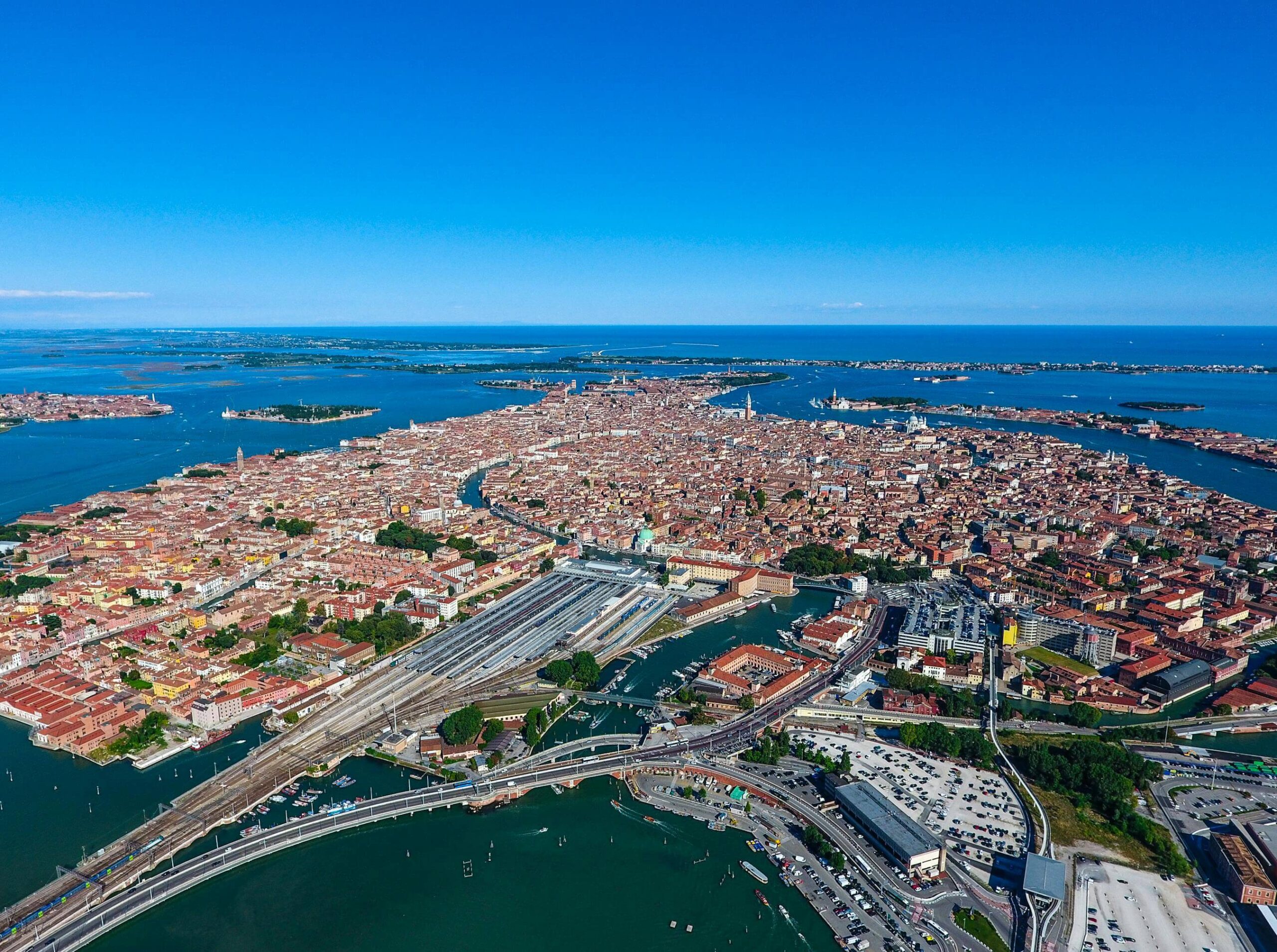
Venice is served by two airports: Venice Marco Polo Airport (VCE), which is the main airport closest to the lagoon, and Treviso Airport (TSF), which is farther away and often used for lower-cost flights. The key point is that road transport ends at Piazzale Roma or Tronchetto: from there, Venice becomes a city of walking, vaporetti, and water taxis. If you arrive at Piazzale Roma, Venezia Santa Lucia railway station is about a 5-minute walk away across the Calatrava Bridge.
Venice Marco Polo Airport (VCE): all real ways to reach Venice
ACTV Aerobus: the standard public bus option
The most straightforward city bus from Marco Polo is the ACTV Aerobus. On the airport page, Venice lists ACTV line 5 as one of the direct road links from the airport to Piazzale Roma, and the same airport page also notes ACTV line 15 for Venezia Mestre station. This is the practical choice if you want the cheapest official public-transport option and do not mind finishing the trip on foot or by vaporetto.
ACTV’s current airport fare structure is clear. A 75-minute airport ticket valid on the mainland road and tram network costs €10 one way, and a 75-minute return ticket costs €18. ACTV also sells an Aerobus + 90-minute Rete Unica ticket for €18, which is useful if you want one combined ticket that covers the airport bus and then a standard Venice public-transport connection, including the waterborne network, after you arrive.
This is usually the best choice for travelers staying near Piazzale Roma, near Santa Lucia, or in Mestre, and for anyone who plans to use ACTV afterward. It is less convenient if your hotel is near San Marco, Rialto, or another canal-side district, because you will still need a second leg by foot or by vaporetto. Official ACTV route maps and fare pages are worth checking before travel because airport supplements and combinations matter in Venice more than in most cities.
ATVO Express Coach: the fastest direct bus to Piazzale Roma
If you want the simplest direct bus from Marco Polo to the city, the ATVO express coach is usually the easiest option. Venice Airport lists ATVO express among the direct connections from Marco Polo to Piazzale Roma and to Venezia Mestre station, and ATVO describes the service as a direct airport coach with air-conditioned buses, luggage space, accessibility for reduced-mobility passengers, and online ticketing.
ATVO’s own Venice guide says the trip from Marco Polo to Piazzale Roma takes about 20 minutes. That makes it the fastest standard bus option into Venice proper. Tickets can be bought online, at ATVO machines in the airport, or at the ticket offices in the arrivals hall; ATVO also states that online buyers can go directly to the departure area, where the airport stop for Venice is in the second lane outside Exit D.
For many visitors, this is the best overall airport transfer: it is faster than a city bus, easier with suitcases, and cheaper than a taxi or private water taxi. It is especially practical if you want a direct run to Piazzale Roma, then a short walk to Santa Lucia or a quick transfer to vaporetto lines serving the Grand Canal and the islands.
Alilaguna water bus: the most “Venice” arrival
If you want to arrive by water instead of by road, the official public option is Alilaguna. Venice Airport lists Alilaguna as one of the airport’s water links to the city, and Alilaguna’s official site shows that the airport is connected by the Blue Line and Orange Line to key areas such as Fondamente Nove, San Marco, Zattere, the Railway Station, Rialto, Sant’Angelo, and Santa Maria del Giglio.
This is the best option if your hotel is close to an Alilaguna stop and you want to avoid the classic “bus to Piazzale Roma, then vaporetto” change. It is slower than the express bus, but it can be more comfortable overall if your final destination is already on the water route. It also gives you a first view of Venice from the lagoon rather than from the road causeway.
Current official Alilaguna fares are €18 one way from the airport to Venice and €32 return. Alilaguna states that the ticket includes one heavy bag and one hand-luggage item, with €4 for each additional bag. The company also sells time-based tickets valid on all Alilaguna lines, but for most airport arrivals the single or return airport ticket is the relevant one.
Private water taxi: the most direct way to a canal-side hotel
Marco Polo is one of the few airports where a private water taxi is a genuine city transfer, not a tourist extra. Venice Airport’s official transport page lists private water taxi / NCC Acqueo from the airport, and the airport also publishes contact details for several water-taxi providers.
This is the most convenient option if you are staying in a hotel with its own landing point, traveling with a lot of luggage, arriving with family, or simply want the smoothest transfer into the historic center. It is far more expensive than the bus or Alilaguna, but it eliminates the road-to-water transfer that defines most Venice arrivals. In practice, it is the premium “door-to-near-door” solution for the lagoon city.
Taxi or private car transfer: best for Piazzale Roma or Mestre
If you want a conventional road taxi, Venice Airport’s official taxi operator is Cooperativa Artigiana Radiotaxi, available 24 hours a day. The airport also publishes fixed airport fares: €40 to Piazzale Roma, €35 to Mestre centre, and €45 to the cruise terminal.
This is a good option for late arrivals, heavy luggage, bad weather, or travelers staying on the mainland. It is important to remember that a road taxi does not take you into Venice’s canalside center; it takes you to the road edge of Venice, typically Piazzale Roma, where you then continue on foot or by boat. If you want a chauffeured road transfer rather than a regular taxi, the airport also offers NCC / private car with driver, including booking through local operators or Uber.
Rental car or self-drive: good for Mestre, not for the historic center
Marco Polo has multiple official car-rental desks, so renting a car is easy if Venice is only one stop on a broader Veneto or northern Italy itinerary. For travelers staying in Mestre, driving onward can make sense. For travelers staying in the historic center, it usually does not. If you need an IDP to rent a car, be sure to obtain one in advance. If you’ve already arrived in Italy, you can apply for an International Driving Permit online and wait for it to arrive in the mail (unless the rental company accepts an electronic version).
If you drive toward Venice proper, you stop at the road terminals. Venezia Unica’s official parking information shows that the Piazzale Roma municipal garage is open 24 hours, has 2,044 parking spaces, and is designed as the automotive terminal with very quick access to the historic center and nearby ACTV waterbus stops. The current 24-hour rate is €35.
Treviso Airport (TSF): all real ways to reach Venice
ATVO Bus Express: the main direct bus from Treviso to Venice
From Treviso Airport, the main direct connection to Venice is the ATVO airport bus express. Treviso Airport’s official transport page lists ATVO for connections to Piazzale Roma, Mestre centre, and Venice Mestre station, and ATVO describes its Treviso service as a non-stop express bus with air conditioning, luggage space, accessibility, and digital tickets.
ATVO’s own Venice guide says the trip from Treviso Airport to Piazzale Roma takes about 70 minutes. That makes it slower than the Marco Polo transfer, but still the most straightforward public option if your destination is Venice proper rather than Treviso itself. Tickets can be bought online, at the airport, and through ATVO retailers.
For most visitors landing at Treviso, this is the default recommendation: it is direct, simple, and removes the need to change to a local bus before reaching Venice. If your hotel is in the historic center, you will still finish the last leg from Piazzale Roma on foot or by vaporetto.
Barzi Service: direct to Mestre and Tronchetto
Treviso Airport’s official transport page also lists Barzi Service, which runs a direct connection to Venice Mestre and Tronchetto. Barzi’s official page says the route goes from Treviso Airport to Mestre train station and Venice Tronchetto, with one stop at Mestre, roughly hourly departures, a journey of about 40 minutes depending on traffic, and a fare of €10 one way or €18 return.
This is a strong option if you specifically want Tronchetto rather than Piazzale Roma. From there, you can continue by ACTV public transport into Venice. ACTV’s official material confirms that the People Mover connects Tronchetto with Piazzale Roma, so this route works well for travelers who do not mind one final short transfer before entering the historic center.
MOM / Treviso Airlink + train: the rail-based alternative
If you prefer a train for the longer part of the journey, Treviso Airport officially recommends the MOM / Treviso Airlink connection to Treviso Centrale. The airport states that MOM line 6 and Treviso Airlink connect the airport with Treviso station, and Mobilità di Marca says the airport shuttle takes about 10 minutes and runs every 30 minutes. From Treviso Centrale, you continue by train toward Venezia Santa Lucia or Venezia Mestre.
This is not the simplest option, but it is a real one and can be useful if you prefer rail ticketing, already have a train itinerary, or are more comfortable navigating train stations than airport coaches. The drawback is obvious: it adds a change, so it is usually less convenient than the direct ATVO bus unless rail is part of your wider trip.
Taxi or private transfer from Treviso Airport
Treviso Airport’s official taxi operator is Radio Taxi Treviso, available 24 hours a day. The airport also lists NCC / chauffeur service, with bookings available through local operators or Uber.
This option is best for night arrivals, groups, families, awkward luggage, or accommodation that is easier to reach by direct road transfer. As with Marco Polo, a car transfer does not carry you into Venice’s canal system; it brings you to the road-access edge, so it is most attractive when time and convenience matter more than price.
Rental car from Treviso Airport
Treviso Airport also has on-site car-rental offices in the Arrivals area on the ground floor. This is practical if Venice is only your first stop and you are heading onward to the Veneto countryside, the Dolomites, or another city.
For a stay in the historic center of Venice, however, a rental car is rarely the best arrival method. You still end at road terminals such as Piazzale Roma, where the city’s automotive infrastructure gives way to water transport and walking.
What happens after you reach Piazzale Roma or Tronchetto
Once you arrive at Piazzale Roma, you are effectively at the gate of Venice. Official city information shows that Piazzale Roma is the bus terminal and road access point, while the airport page confirms that Santa Lucia station is a short walk away. From Piazzale Roma, you can continue on foot, take an ACTV vaporetto, or use a water taxi. ACTV’s official map shows the main waterbus hubs including Piazzale Roma, Ferrovia, Rialto, San Marco, and Fondamente Nove.
If you arrive at Tronchetto, the most useful official onward connection is the People Mover to Piazzale Roma. From there, you transfer to walking routes or ACTV water transport.
For local public transport inside Venice, ACTV’s current official fare page lists a standard 75-minute Rete Unica ticket at €9.50 for the city waterborne network and a standard 75-minute road-network ticket at €1.50 for mainland buses, trams, and the People Mover. That difference matters: a Venice bus ticket and a Venice vaporetto ticket are not the same thing.
Important extra cost: Venice Access Fee
One more point matters in 2026, especially for day visitors. Venice’s official Access Fee platform states that on certain 2026 dates the historic center has an Access Fee, and the official purchase page lists the current amount as €5 if paid by the fourth day before access and €10 if paid later. The same official page also states that visitors staying in accommodation within the Municipality of Venice do not need to purchase it on that site.
This fee is separate from airport transfers and local transport. It does not replace your bus, boat, or taxi ticket, so it is worth checking the official Venice page before travel, especially if you are arriving for a same-day visit.
Which option is best?
For speed and simplicity from Marco Polo, the best choice is usually ATVO Express. For the cheapest official public route, use ACTV Aerobus. For the most atmospheric arrival, take Alilaguna if your hotel is near one of its stops. For the smoothest door-to-near-door transfer into the lagoon, choose a private water taxi.
From Treviso Airport, the most practical default is the ATVO direct bus. Choose Barzi if Tronchetto suits your route better, and choose MOM + train if you specifically prefer a rail-based last leg. Taxis and private transfers make sense mainly for late arrivals, families, and travelers who value directness over budget.
Useful official sources
For current schedules, fares, and purchase pages, these are the official references worth using: Venice Marco Polo Airport transport , Treviso Airport transport , ACTV fares and route maps , Alilaguna lines and fares , ATVO airport buses , MOM Treviso Airlink , and the official Venice Access Fee page