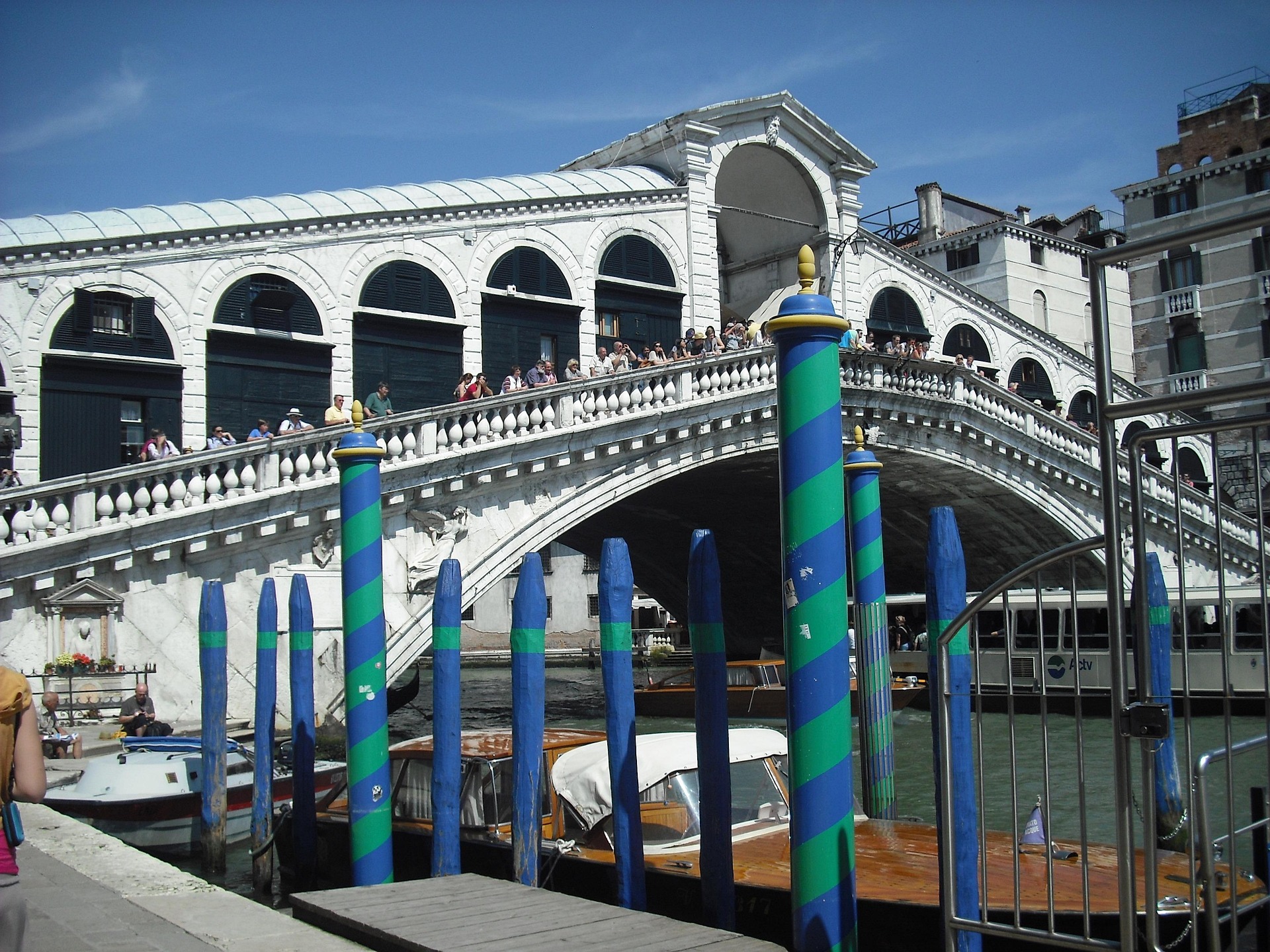
The Rialto Bridge, or Ponte di Rialto, is one of the best-known landmarks in Venice. It crosses the Grand Canal between the districts of San Marco and San Polo, in an area that was the commercial heart of the Venetian Republic for centuries. Today thousands of people cross it every day, but the bridge was originally built for a very practical reason: merchants, residents and goods needed an easy way to move between the two sides of the city.
The stone bridge we see today dates from the late 16th century. However, people had been crossing the Grand Canal at Rialto for more than 400 years before it appeared.
The History of the Rialto Bridge
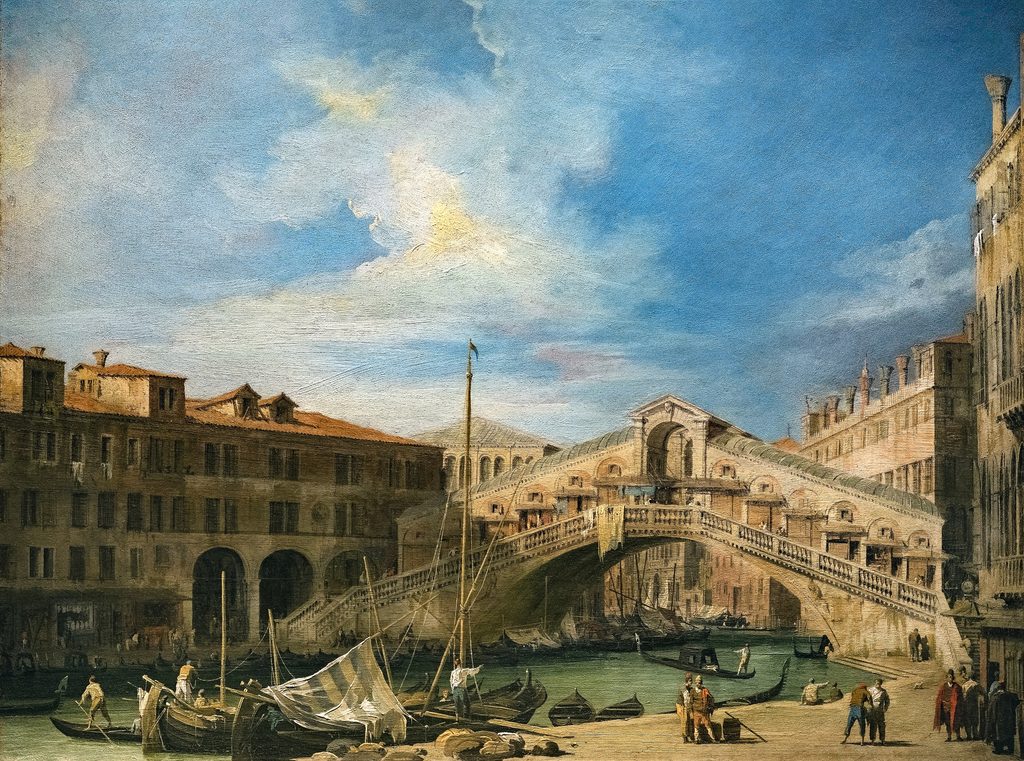
Canaletto, CC BY-SA 4.0 https://creativecommons.org/licenses/by-sa/4.0, via Wikimedia Commons
The first bridge at this point appeared in the late 12th century. It was a floating pontoon bridge traditionally associated with engineer Nicolò Barattieri and was known as Ponte della Moneta. As the nearby Rialto market grew, this simple crossing could no longer handle the increasing number of merchants and customers.
Around the middle of the 13th century it was replaced by a wooden bridge. Its central section could be raised so that larger boats could continue along the Grand Canal. Shops were later added to the bridge, and rent from them helped the Venetian government pay for maintenance.
The wooden structure had a difficult history. It was damaged during the revolt of Bajamonte Tiepolo in 1310, collapsed under a large crowd watching a wedding procession in 1444 and suffered another major collapse in 1524. Venice eventually decided that its most important commercial crossing needed a permanent stone replacement.
Several famous architects proposed designs, including Andrea Palladio, Jacopo Sansovino and Vignola. The design that was actually chosen, however, belonged to Venetian architect and engineer Antonio da Ponte. Construction began in 1588, and the bridge was substantially completed in 1591.
Da Ponte chose one large stone arch rather than several smaller arches. The span is more than 28 metres wide, while the foundations rest on thousands of timber piles driven into the lagoon soil. The bridge also contains 24 shops, continuing the commercial tradition of the earlier wooden bridge.
For centuries, Rialto was also much more important than it may appear today. Until 1854, it was the only bridge across the Grand Canal, so anyone who did not use a boat had to cross here.
A short timeline makes its long history easier to understand:
- Late 1100s: first pontoon crossing at Rialto.
- 13th century: a wooden bridge replaces it.
- 1310: the bridge is damaged during a revolt.
- 1444: the wooden bridge collapses under a crowd.
- 1524: another serious collapse occurs.
- 1588–1591: Antonio da Ponte builds the present stone bridge.
Legends and Myths of the Rialto Bridge
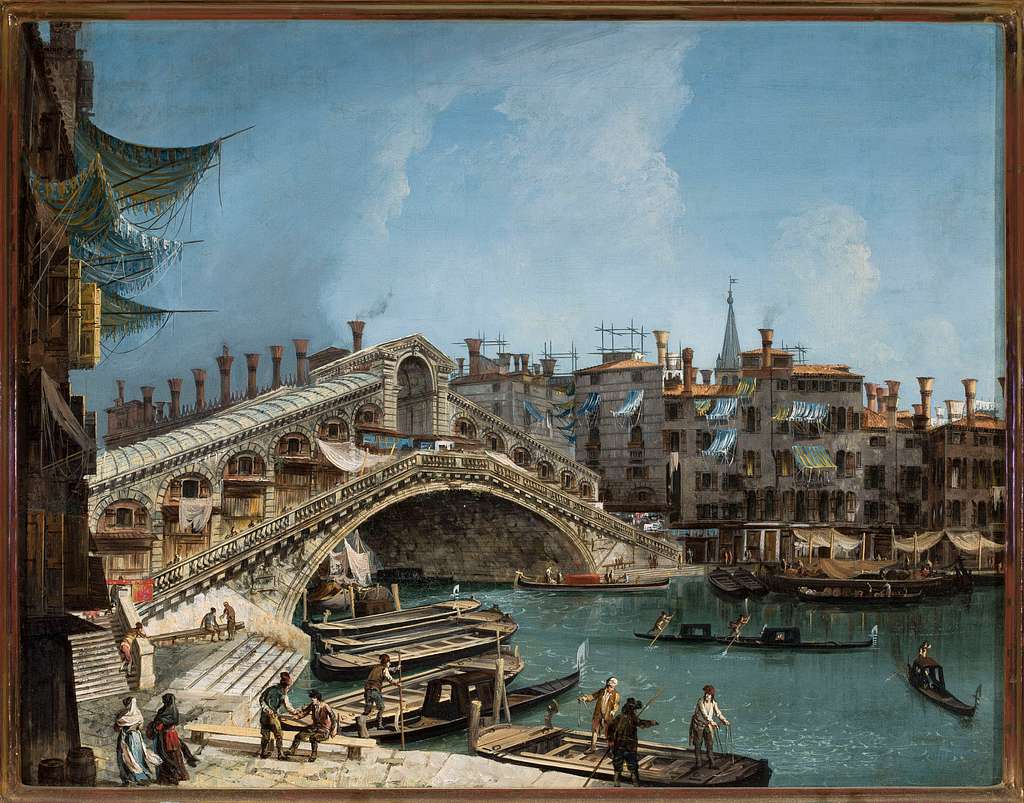
A monument this famous naturally collected stories that are much less reliable than its documented history.
The most famous is the legend of Antonio da Ponte and the devil. According to the story, construction kept going wrong until the devil offered to guarantee that the bridge would stand. In exchange, he demanded the soul of the first living creature to cross it.
Da Ponte supposedly tried to trick him by arranging for a rooster to cross first. The devil discovered the plan and took revenge by causing the architect’s pregnant wife to become the first person to walk onto the bridge. Some versions of the legend say that the spirits of the woman and her unborn child continued to haunt the bridge. This is Venetian folklore, not a documented event.
Another story concerns the people who believed Da Ponte’s single stone arch could never remain standing. Local tradition says some Venetians made very rude promises about what they would do if the bridge survived. Strange carved figures on the nearby Palazzo dei Camerlenghi have traditionally been linked with these insults, although the connection belongs more to local storytelling than proven architectural history.
There is also a common modern misconception that Palladio or Michelangelo designed the Rialto Bridge. Famous Renaissance architects were indeed connected with proposals for a new bridge, but the structure standing today is Antonio da Ponte’s design.
The Rialto Bridge Today
Today the bridge still performs the same basic job it did centuries ago: it connects two busy parts of Venice. At the same time, it has become one of the city’s main sightseeing spots and one of the most photographed places on the Grand Canal.
The covered central section is still lined with shops. Jewellery, glass products, leather goods, souvenirs and other items are sold in spaces that continue a commercial tradition stretching back hundreds of years. From the outer stairs, there are open terraces where visitors can stop and look along the Grand Canal.
Crossing the bridge itself is free and it never functions like a museum with opening hours. The main problem is simply the crowd: between late morning and early evening, stopping for photographs can be difficult.
How to Get to the Rialto Bridge by Vaporetto
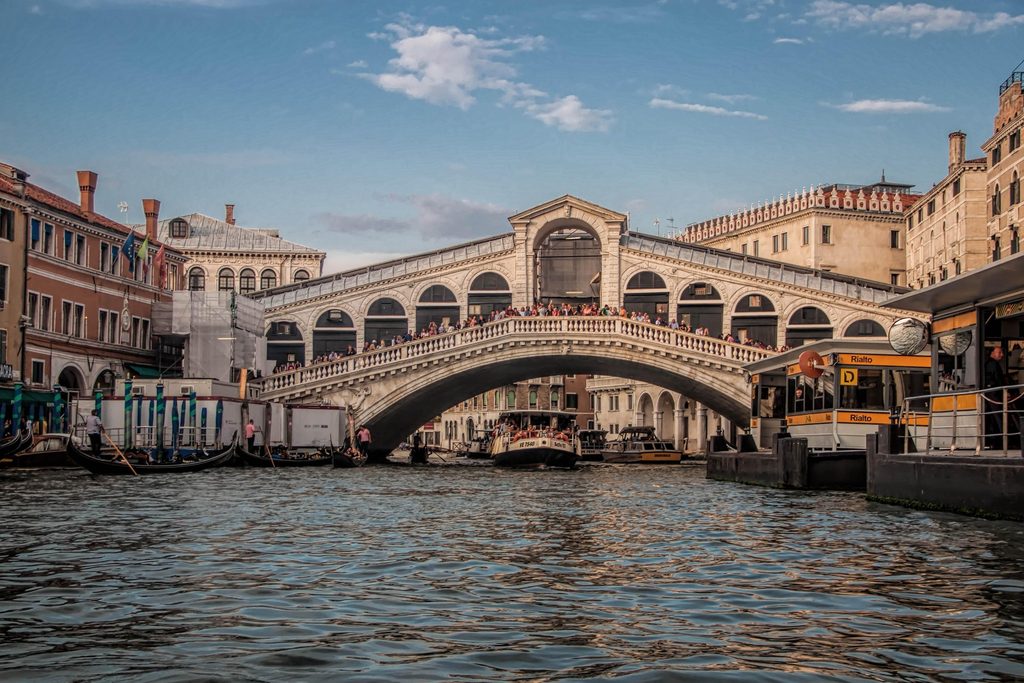
The easiest water route is usually ACTV Line 1, which travels along the Grand Canal and stops at Rialto. It connects the area with Piazzale Roma, Venezia Santa Lucia railway station, San Marco and other important stops. Line 1 also passes directly under the bridge, so the journey itself provides one of the best views of Rialto from the water.
There are actually stops on both sides of the canal. Rialto is on the San Marco side, very close to the bridge, while Rialto Mercato provides convenient access to the market on the San Polo side. Line 2 and Line 2/ services can also serve Rialto, but their routes and operating periods change according to season, so Line 1 is normally the simplest option for visitors.
A vaporetto approach is especially worthwhile on a first visit. You see the bridge gradually appear between the palaces before the boat passes underneath its large stone arch.
How to Walk to the Rialto Bridge
From St Mark’s Square, the bridge is roughly a 10-minute walk. Follow the yellow street signs marked Per Rialto. The route passes through narrow shopping streets and small squares, and it can become extremely busy during the middle of the day.
From Santa Lucia railway station, allow around 20–25 minutes on foot. Venice’s street layout means the shortest-looking route on a map is not always the easiest, so following signs for Rialto is often simpler than trying to navigate every small calle individually.
Walking is worthwhile because the streets around Rialto are part of the experience. However, travellers with heavy suitcases will usually find the vaporetto much easier because the walking route includes numerous bridges and steps.
Best Places to Photograph the Rialto Bridge
The top of the bridge gives excellent views from Rialto, but not the best photographs of the bridge itself. For that, move down to the banks of the Grand Canal.
- Riva del Vin, San Polo side: one of the best full views of the bridge. Sunrise and early morning are ideal because there are fewer people and softer light. From late spring through summer, early morning can produce attractive backlighting behind the bridge.
- Riva del Carbon / San Marco side: useful for a side view with boats and the Grand Canal in the foreground. Early morning or the last light of the afternoon generally works better than midday.
- From the top of Rialto: look southwest along the Grand Canal around sunset. This is one of the classic Venice views, although you are photographing the canal rather than the bridge itself.
- From a vaporetto: Line 1 gives a moving water-level view immediately before and after passing under the arch. Standing in an outdoor section of the boat gives the best chance of a clear photograph.
For photographs without crowds, arrive around sunrise. Around sunset the light can be beautiful, but the bridge and surrounding quays are normally much busier. After dark is another good option: the illuminated arch reflects in the Grand Canal and most day-trip groups have already left.
What to See Near the Rialto Bridge
The obvious next stop is the Rialto Market, only a few minutes away on the San Polo side. The fruit and vegetable market currently operates Monday to Saturday, while the traditional fish market normally runs from Tuesday to Saturday in the morning. Visiting before lunchtime gives a much better sense of the area as a working market rather than simply a tourist attraction.
Nearby Campo San Giacomo di Rialto belongs to the historic commercial district that gave the bridge its importance in the first place. Around the square and neighbouring streets you will find old arcades, small shops, bacari and passages leading towards San Polo.
On the opposite side of the bridge stands the large Fondaco dei Tedeschi, historically used by German merchants. Older travel guides often recommend its rooftop terrace, but visitors should note that the former DFS store and rooftop closed to the public in 2025.
From Rialto it is also easy to continue towards St Mark’s Square, which takes only a short walk, or head deeper into San Polo towards the Frari church and quieter residential streets.
Restaurants with a View of the Rialto Bridge
Several restaurants occupy the waterfront directly beside Rialto, especially along Riva del Vin on the San Polo side. A table beside the Grand Canal can provide an excellent view of the bridge, gondolas and passing vaporetti, particularly around sunset and after the lights come on. Some terraces sit only a few metres from the water.
The location, however, comes at a price. Restaurants immediately around one of Venice’s most famous monuments tend to charge more than places a few streets inland, and a restaurant advertising a “Rialto view” does not necessarily mean every table has one. When booking, ask specifically for a canal-side table facing the bridge rather than simply requesting an outdoor table.
Sunset tables should be reserved in advance, especially from spring through early autumn. Remember that awnings, mooring poles and passing boats may partly block the view from some positions, while tables closest to the canal usually disappear first.
If food quality matters more than the view, another good strategy is to eat several streets away in San Polo and return to Riva del Vin afterward for an evening walk. If the experience of dining beside the Grand Canal is the main attraction, then paying extra for a genuine waterfront table can be worth it.
Why the Rialto Bridge Still Matters
The Rialto Bridge is not famous only because it is beautiful. It tells the story of Venice as a trading city: first a simple crossing beside a market, then a wooden commercial bridge, and finally an ambitious stone structure built at the height of the Venetian Republic.
More than four centuries later, people still shop on it, cross it on their way through the city and watch boats pass beneath the same single arch. That continuity is what makes Rialto more interesting than a monument preserved only for tourists — it is still part of the everyday movement of Venice.