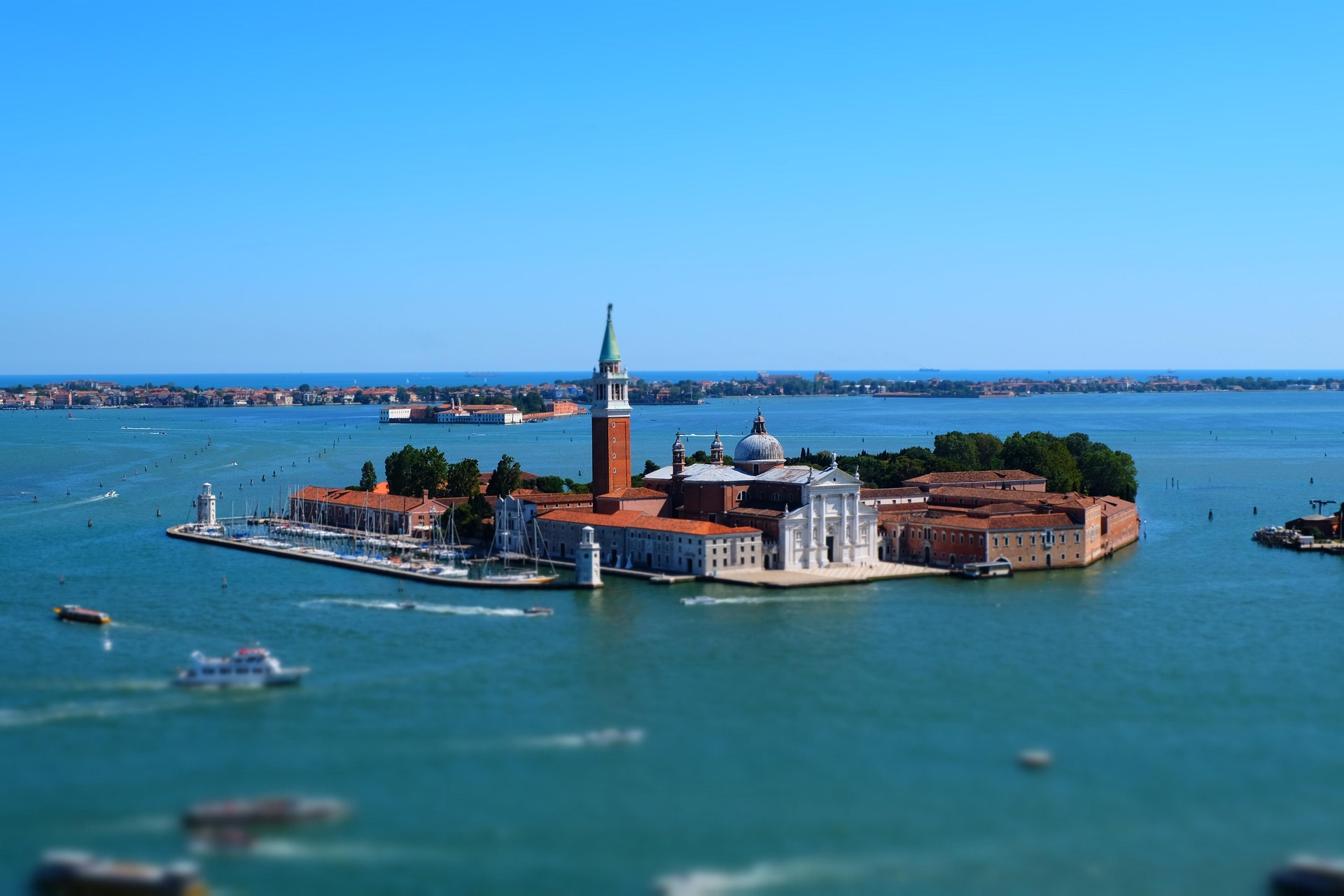
San Giorgio Maggiore is the small island directly opposite St Mark’s Square, separated from central Venice by the waters of the San Marco Basin. Its white church façade and tall brick bell tower form one of the most familiar views in Venice, yet surprisingly few visitors actually cross the water to explore the island.
That makes San Giorgio particularly appealing. You can see important Renaissance architecture, paintings by Tintoretto, one of the best panoramas of Venice and contemporary exhibitions without the crowds found around Piazza San Marco. Most visitors need only two or three hours, making the island an easy addition to a day in Venice.
The History of San Giorgio Maggiore
The island has been connected with religious life for more than a thousand years. A church dedicated to Saint George existed here by the early Middle Ages, and in 982 a Benedictine monastery was established on the island. Over the centuries the monastery became an important religious and cultural institution closely connected with the history of the Venetian Republic.
The appearance visitors see today was largely created during the Renaissance. In 1566, the Benedictines commissioned Andrea Palladio, one of Italy’s most influential architects, to design a new church. Palladio created the monumental classical building facing the lagoon, with a bright façade intended to be clearly visible from the political and ceremonial centre of Venice across the water. The basilica was completed after Palladio’s death and consecrated in 1610.
The monastery was later transformed during the Napoleonic period, and parts of the complex were used for military purposes. A new chapter began in 1951, when the Fondazione Giorgio Cini was established on the island. The foundation restored large sections of the former monastery and turned San Giorgio into an important centre for art, music, research and exhibitions.
Basilica of San Giorgio Maggiore and the Bell Tower
The Basilica of San Giorgio Maggiore is the island’s principal attraction. Palladio designed its white façade using forms inspired by classical Roman temples, while the large dome and red-brick buildings behind it create the silhouette visible from the Riva degli Schiavoni and St Mark’s Square.
The interior feels lighter and less heavily decorated than many Venetian churches. Among its greatest treasures are major works by Jacopo Tintoretto, including The Last Supper and The Gathering of the Manna. Their dramatic light and unusual perspectives make them worth seeing even for visitors who normally spend little time in churches.
Beside the basilica stands the Campanile di San Giorgio Maggiore. The earlier bell tower collapsed in 1774, and the present structure was completed in 1791. Visitors can reach the upper level by elevator, so there is no long staircase to climb.
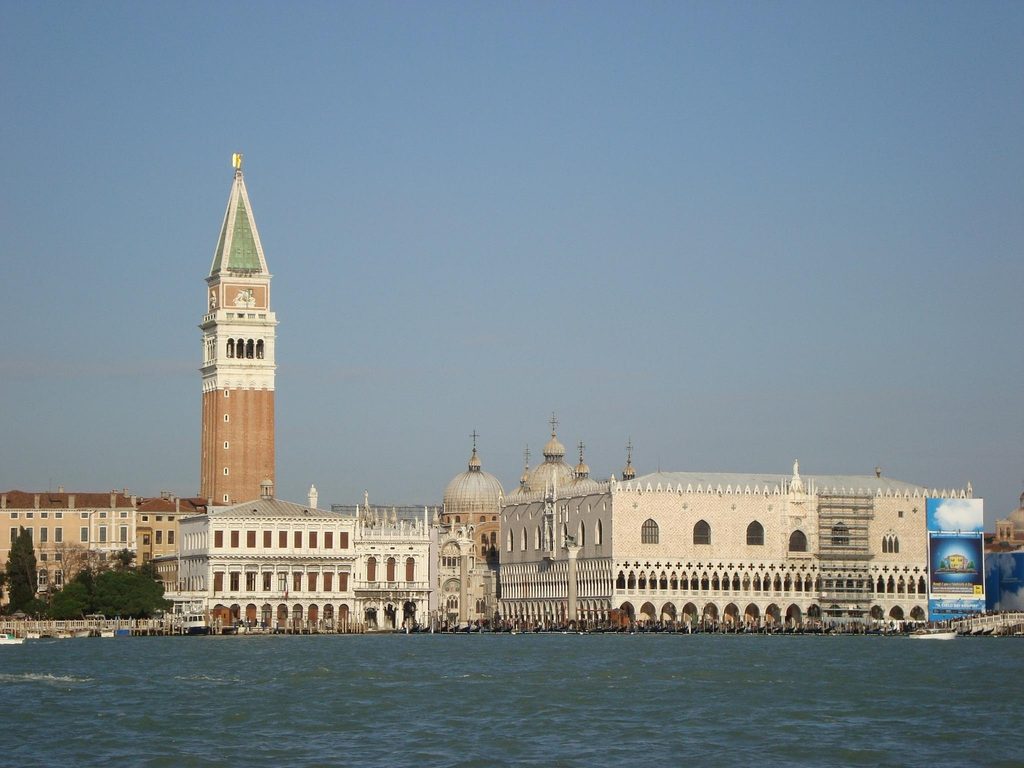
The view from the tower is arguably the main reason not to treat San Giorgio as something to admire only from across the lagoon. Directly opposite are the Doge’s Palace, St Mark’s Campanile and the domes of the basilica; farther away you can see Santa Maria della Salute, Giudecca, the lagoon islands and, on clear days, a huge stretch of the Venetian Lagoon.
For photographs, late afternoon can be particularly attractive because the historic centre lies across the water in front of you. Morning, however, normally means fewer visitors and clearer conditions during hot summer weather.
What Else Is There to See on the Island?
San Giorgio is much larger than the basilica alone. The former Benedictine monastery contains remarkable Renaissance architecture, including cloisters and spaces associated with Palladio and later architects. Much of this area is now managed by the Fondazione Giorgio Cini, and access to some parts requires a guided or organised visit rather than simply walking in from the waterfront.
The island has gradually become an important cultural destination. Le Stanze del Vetro presents exhibitions devoted to glass and glassmaking, while Le Stanze della Fotografia focuses on photography. There is also the Auditorium Lo Squero, created inside a former boatyard and now used for concerts, with large windows facing the lagoon.
One of the island’s more unusual attractions is the Borges Labyrinth, inspired by Argentine writer Jorge Luis Borges. Its paths form a large green maze based on symbols connected with his life and writing. Another contemporary attraction is the Vatican Chapels, a group of modern chapels created for the 2018 Venice Architecture Biennale in a wooded part of the island.
Because many of these places belong to the Cini Foundation, it is worth deciding before your visit whether you simply want to see the basilica and bell tower or want to explore the island more deeply. Guided visits open parts of San Giorgio that casual visitors would otherwise miss.
The Best View of Venice from San Giorgio
San Giorgio offers one of the best viewpoints in the entire city because Venice is across the water rather than immediately beneath you. From the waterfront in front of the basilica, the Doge’s Palace and St Mark’s Campanile appear together in a single panorama, with boats constantly crossing the San Marco Basin.
The view becomes even better from the campanile. Unlike St Mark’s Campanile, where San Giorgio dominates the view across the lagoon, here you are looking directly back at the most famous part of Venice. The distance is perfect for understanding how the Doge’s Palace, St Mark’s Basilica, waterfront and surrounding rooftops fit together.
Sunset is beautiful, but photographers should remember that the sun’s exact position changes considerably through the year. For a simple photograph of San Marco with pleasant light and fewer crowds, morning or later afternoon is usually easier than the middle of the day.
There is also a good reason to see the island from Venice before visiting it. Walk to the waterfront beside the Doge’s Palace or along Riva degli Schiavoni and look across the basin. The symmetrical white façade of Palladio’s church was deliberately designed to be seen from this direction, and arriving on the island afterward gives you a completely different perspective on the same building.
How to Get to San Giorgio Maggiore
There is no pedestrian bridge to the island, so visitors must arrive by boat. The simplest public transport option is ACTV vaporetto Line 2, which stops at San Giorgio directly in front of the basilica.
From the San Marco area, use the San Zaccaria landing stages; the crossing is very short. Line 2 also connects San Giorgio with areas including Piazzale Roma and Venezia Santa Lucia railway station, although travelling from those locations takes longer.
Because the island is so close to San Marco, it works particularly well as a short excursion during a day in central Venice. You can leave the busiest streets around St Mark’s Square, cross the water, spend a couple of quiet hours on San Giorgio and return without dedicating an entire day to the trip.
How Much Time Do You Need and Is San Giorgio Worth Visiting?
Allow around one to two hours if you only want to see the basilica, go up the bell tower and enjoy the waterfront. Two to three hours is more comfortable if you also want to visit exhibitions or explore parts of the Fondazione Giorgio Cini complex. A longer stay makes sense mainly if you have booked a guided tour or are attending an exhibition or concert.
San Giorgio Maggiore is especially worthwhile for travellers who have already seen Venice’s obvious landmarks. It provides a quieter atmosphere, important Renaissance architecture and perhaps the best elevated view back towards St Mark’s Square.
Most importantly, the island changes the way you see Venice. From Piazza San Marco, San Giorgio is part of the scenery; once you cross the lagoon and look back, Venice itself becomes the view.