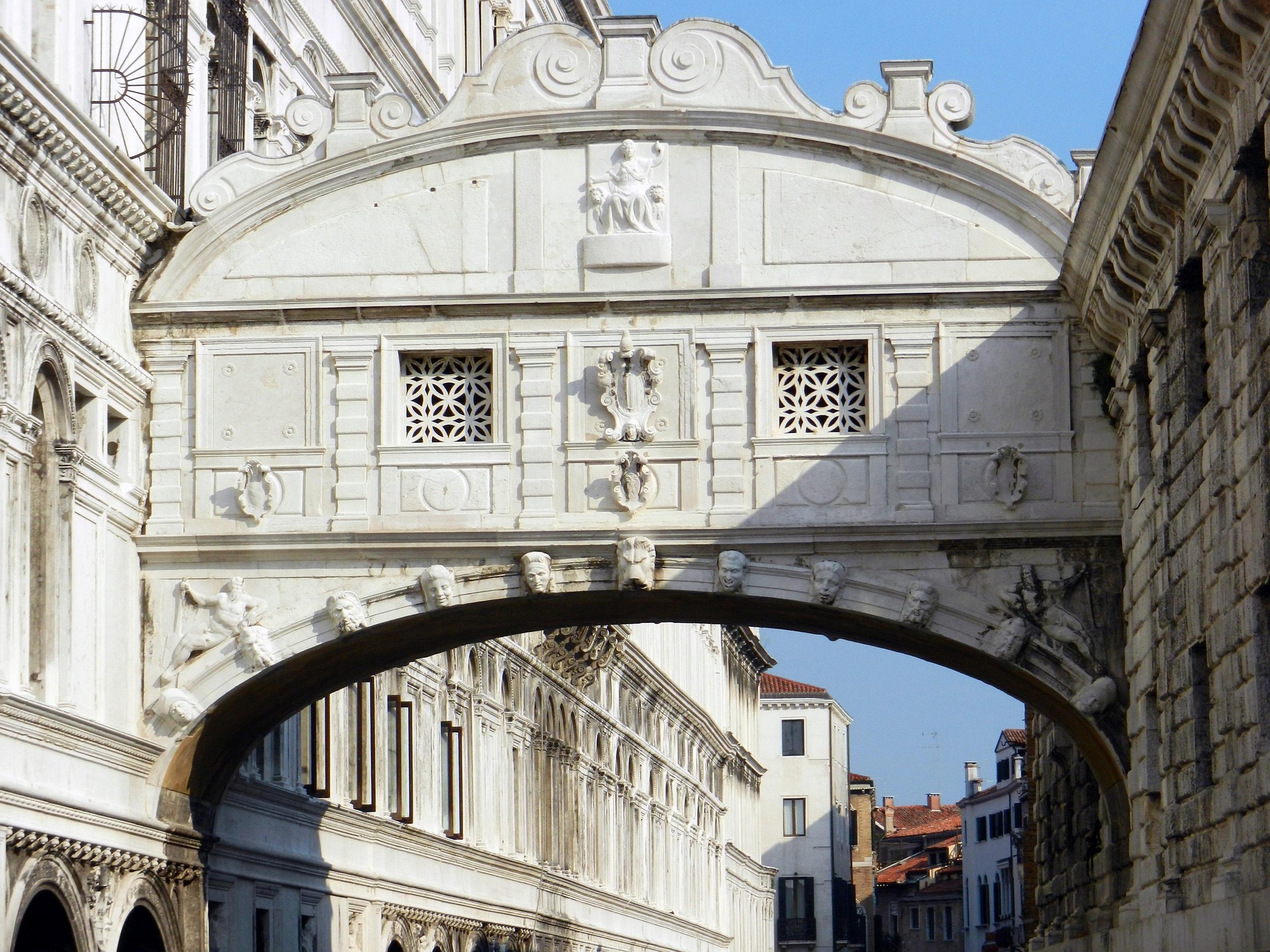
The Bridge of Sighs, or Ponte dei Sospiri, is one of the most famous bridges in Venice. It crosses the narrow Rio di Palazzo beside the Doge’s Palace, connecting the former government building with the New Prisons. Its white stone, small windows and unusual enclosed shape make it instantly recognisable.
Today it is often presented as one of Venice’s most romantic places. Its real history, however, has much more to do with courts, prisoners and the justice system of the Venetian Republic.
The History of the Bridge of Sighs
The bridge was created in the early 17th century as part of a major expansion of the prison complex beside the Doge’s Palace. The official Doge’s Palace museum explains that the New Prisons were built across the canal and connected to the palace by the Bridge of Sighs; its present visitor route dates the bridge to 1614. The design is generally attributed to Venetian architect Antonio Contin, a relative of Antonio da Ponte, who designed the Rialto Bridge.
Unlike Rialto, the Bridge of Sighs was never intended for ordinary pedestrians. It was an internal passage used to move prisoners between the rooms where Venetian justice was administered and their cells in the New Prisons.
The bridge is completely enclosed and contains two separate narrow corridors. This arrangement allowed different groups of prisoners and officials to move through the structure without meeting one another. Small stone lattice windows provided only limited views of the canal outside.
The pale exterior is made from Istrian stone, a material used throughout historic Venice because of its strength and resistance to the lagoon environment. Above the arch are decorative carvings and the coat of arms connected with Doge Marino Grimani, during whose period of rule the project was developed.
Why Is It Called the Bridge of Sighs?
The famous explanation is that condemned prisoners crossed the bridge, looked through its small windows at Venice for the last time and sighed before disappearing into prison.
It is a powerful story, but it should not be treated as a literal historical record. Many prisoners who crossed the bridge were not going to their deaths, and the romantic image of a final look at Venice became popular much later. The name was famously reinforced in the English-speaking world by Lord Byron, who referred to the Bridge of Sighs in Childe Harold’s Pilgrimage.
The result is a good example of how Venice mixes real history with later storytelling. The bridge was genuinely part of the prison system, but its melancholy reputation became much larger than its original practical purpose.
The Legend of the Kiss Under the Bridge
Strangely, a bridge associated with prisoners eventually became a symbol of love.
According to a modern legend, a couple who kiss in a gondola while passing beneath the Bridge of Sighs at sunset will remain in love forever. Some versions add that the bells of St Mark’s must be ringing at the same moment.
This is not an old Venetian tradition. The romantic story became popular mainly during the 20th century and was helped by books, tourism and films, including A Little Romance from 1979. It has little historical connection with the original bridge, but it remains one of the best-known romantic legends in Venice.
Can You Walk Across the Bridge of Sighs?
Yes, but you cannot simply walk onto it from the street.
The bridge is part of the Doge’s Palace museum route. Visitors move from the palace through one of its internal corridors and continue into the New Prisons, following essentially the same connection once used within the Venetian justice system. The official museum route includes the bridge and prison areas.
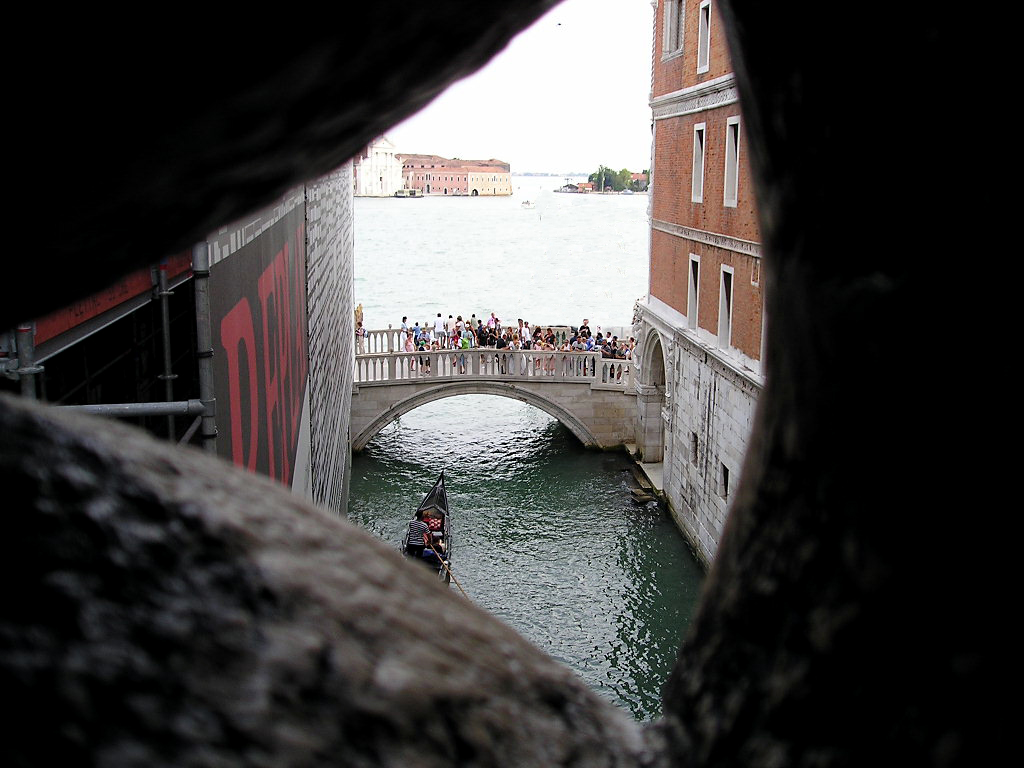
From inside, you can look through the small stone windows towards the canal. The view is deliberately restricted, which makes it easier to understand why the bridge feels very different from its elegant exterior.
The special Secret Itineraries Tour explores additional areas connected with the Venetian justice system, including rooms associated with the Council of Ten and the famous Piombi prison cells where Giacomo Casanova was held. Casanova escaped from the Doge’s Palace in 1756, although the popular claim that his escape happened through the Bridge of Sighs is incorrect.
How to Get to the Bridge of Sighs
The bridge is immediately beside Piazza San Marco, so it is one of the easiest major monuments to find in Venice. From St Mark’s Basilica, walk towards the Doge’s Palace and then along the waterfront promenade, Riva degli Schiavoni. Within a few minutes you will reach Ponte della Paglia, from where the classic view of the Bridge of Sighs opens along the canal.
If you are arriving by vaporetto, use one of the San Marco–San Zaccaria stops. Several ACTV routes serve this large group of landing stages, and the bridge is only a few minutes away on foot. ACTV service patterns can change seasonally, so it is better to check the current route shortly before travelling.
From Rialto Bridge, the walk normally takes around 10–15 minutes through the San Marco district. From Venezia Santa Lucia railway station, taking a vaporetto is usually more comfortable than walking if you have luggage.
Best Places to Photograph the Bridge of Sighs
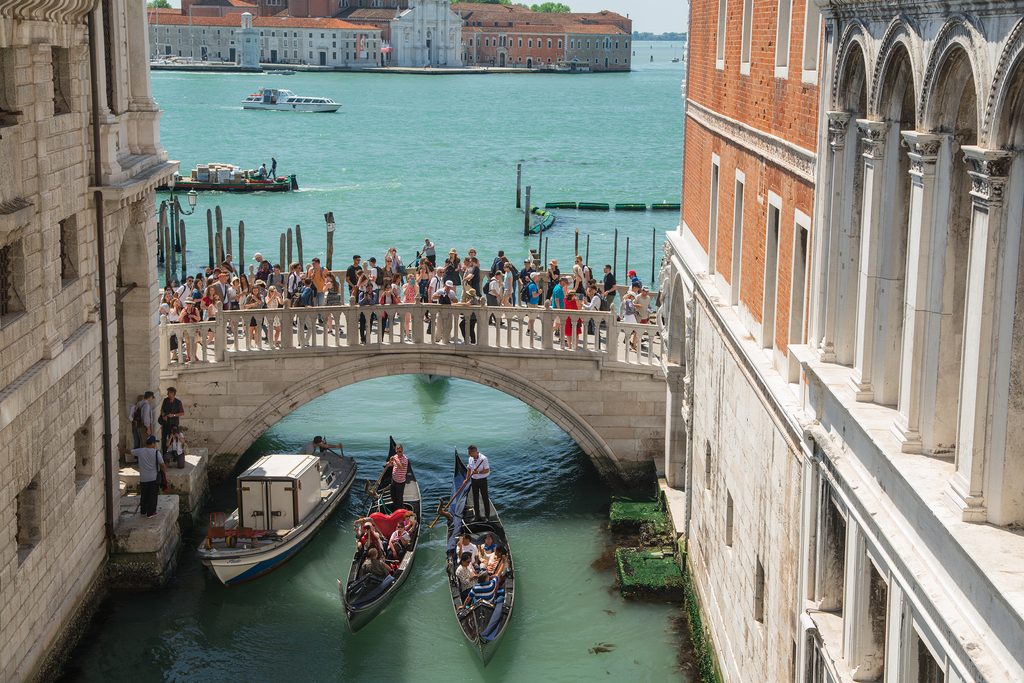
The bridge is surprisingly difficult to photograph from many angles because it sits inside a very narrow canal between tall buildings. Fortunately, there are two excellent public viewpoints.
- Ponte della Paglia: the classic viewpoint beside the Doge’s Palace. You look north along Rio di Palazzo with the bridge framed between the palace and prison walls. Early morning is the best time for fewer people, calmer water and gondolas entering the canal.
- Ponte de Canonica: located on the opposite, northern side of the Bridge of Sighs. It gives a less famous reverse view and is usually quieter than Ponte della Paglia. Late afternoon can give attractive side light on the surrounding buildings.
For the traditional postcard photograph, Ponte della Paglia is the better choice. Sunrise and the first hours of the morning are especially useful because this area becomes extremely crowded once tour groups arrive.
A gondola provides a completely different perspective. Boats travelling through Rio di Palazzo pass directly beneath the bridge, allowing you to see its stone arch from water level.
What to See Near the Bridge of Sighs
The bridge stands in the middle of one of the richest sightseeing areas in Venice. You can easily combine it with several major attractions without using any transport:
- Doge’s Palace, including the interior of the bridge and New Prisons;
- St Mark’s Basilica and Piazza San Marco;
- St Mark’s Campanile;
- Riva degli Schiavoni, the waterfront promenade;
- San Zaccaria Church, a few minutes east of the bridge.
If you continue east along the waterfront, the crowds gradually become thinner as you move towards Castello. Walking west brings you back to Piazza San Marco and the narrow streets leading towards Rialto.
Restaurants Near the Bridge of Sighs
There is an important difference between eating near the Bridge of Sighs and eating with a view of it. Because the bridge crosses a narrow service canal between the Doge’s Palace and the former prisons, there are no large restaurant terraces directly facing it in the way restaurants face the Rialto Bridge.
Restaurants and cafés can instead be found around Riva degli Schiavoni, Piazza San Marco and the streets towards Campo San Zaccaria. Waterfront tables here can have beautiful lagoon views, but they usually do not offer a direct view of the Bridge of Sighs.
The immediate San Marco area is also one of the most expensive places to eat in Venice. Check the menu before sitting down, especially the prices for drinks, seafood and any coperto or service charge. Walking five or ten minutes into Castello can often provide a quieter atmosphere and better value.