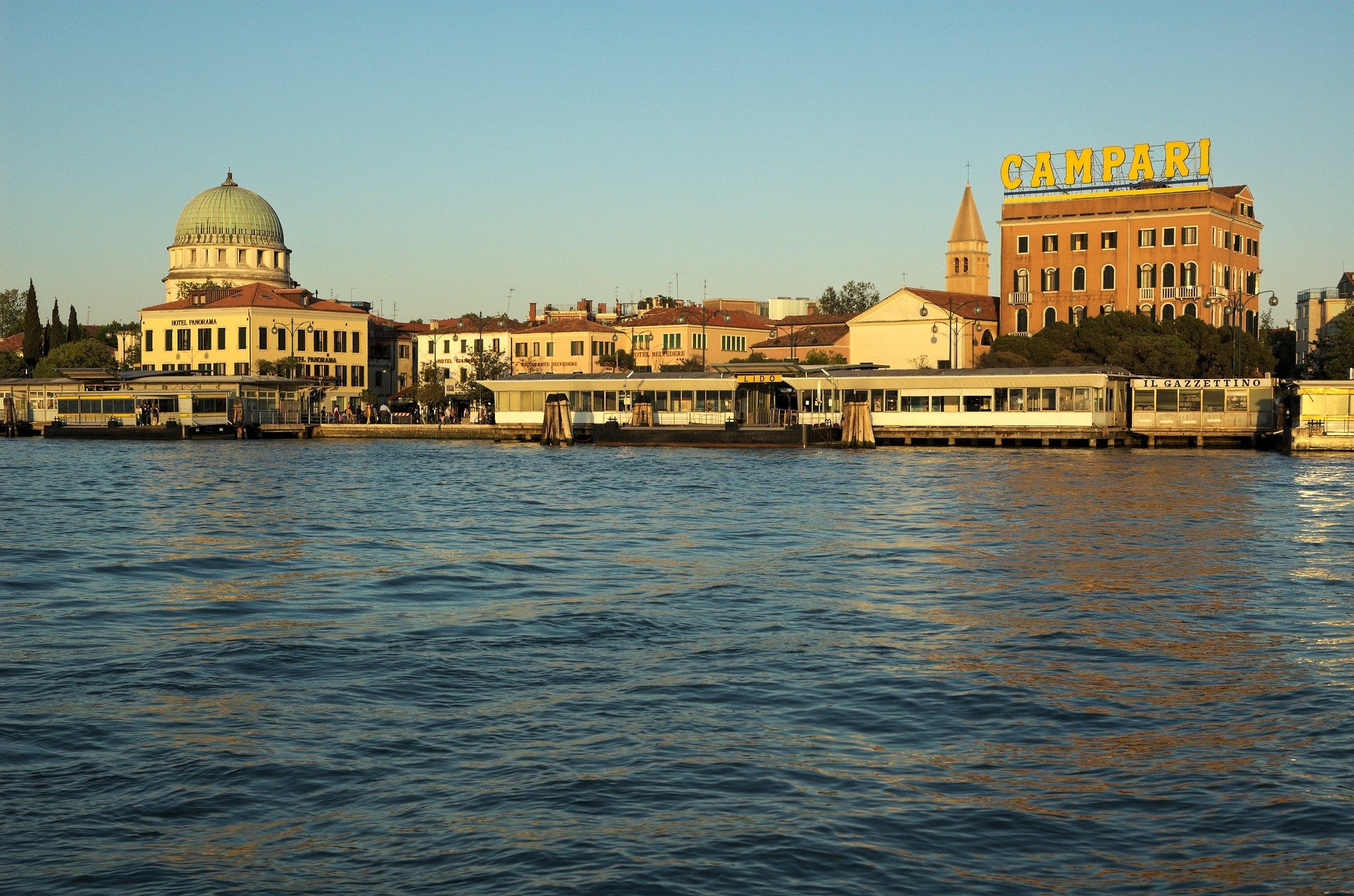
Venice Lido is separated from the historic centre by the Venetian Lagoon, so there is no conventional train, metro, or road connection from Venezia Santa Lucia railway station. For most travellers, the easiest way to reach the island is by vaporetto, Venice’s public water bus.
Several direct water-bus routes connect the railway station with Lido Santa Maria Elisabetta, usually abbreviated as Lido S.M.E. Depending on the service selected, the journey takes approximately 40 to 65 minutes. Private water taxis are also available for travellers who prefer a faster and more comfortable transfer.
Finding the Vaporetto Stops at Santa Lucia Station
After leaving the main entrance of Venezia Santa Lucia station, you will immediately see the Grand Canal. The vaporetto platforms are directly in front of the station and are identified collectively as Ferrovia, the Italian word for railway.
Ferrovia has several separate boarding platforms marked with letters. Different routes may depart from different platforms, so passengers should check the electronic departure screens rather than relying only on the platform letter. Under the current operating pattern, Line 5.1 normally uses Ferrovia C, while Lines 1 and 2 may use other Ferrovia platforms depending on the time of day.
Tickets are available from Venezia Unica and ACTV ticket offices, vending machines, authorised retailers, and the official transport application. A ticket must be validated before boarding and again whenever changing to another form of ACTV transport.
Option 1: ACTV Line 5.1 — Usually the Most Convenient Route
For many travellers, Line 5.1 offers the best combination of speed and convenience. It provides a direct service from Ferrovia to Lido S.M.E., so there is no need to carry luggage between boats.
After leaving Ferrovia, the route continues through Piazzale Roma and along the southern side of Venice, stopping at places such as Zattere, San Marco–San Zaccaria, Giardini Biennale, and Sant’Elena before reaching Lido. Based on the published timetable, the section from Ferrovia to Lido normally takes approximately 38 to 40 minutes.
Line 5.1 is particularly suitable for passengers carrying suitcases because it avoids the slower journey through almost the entire Grand Canal. It is also convenient for visitors whose accommodation is near the main Lido terminal or around Gran Viale Santa Maria Elisabetta.
Before boarding, make sure the destination screen shows Lido S.M.E. Line 5.1 is circular, and taking it in the wrong direction would result in a much longer journey around northern Venice.
Option 2: ACTV Line 2 — A Faster Grand Canal Route
Line 2 is another direct option from Ferrovia to Lido. It follows the Grand Canal but makes fewer stops than Line 1, passing important locations such as Rialto, San Marco, and Giardini before arriving at Lido S.M.E.
The journey generally takes around 40 to 50 minutes, depending on the exact departure and operating pattern. During periods when the complete route is running, Line 2 is one of the most practical choices for passengers who want to see part of the Grand Canal without spending as long on the boat as they would on Line 1.
Service patterns on Line 2 can change according to the season and time of day. Some boats change their route number during the journey or terminate before Lido, so passengers should confirm the destination on the electronic display and departure board.
Option 3: ACTV Line 1 — The Most Scenic Journey
Travellers who are not in a hurry may prefer Line 1. This is the classic Grand Canal vaporetto route, running from Ferrovia past historic palaces, Rialto, Accademia, the Salute church, St Mark’s Square, the Arsenale, Giardini, and Sant’Elena before reaching Lido.
The journey normally takes approximately 55 to 65 minutes. Although it is slower, it can serve as an inexpensive introductory sightseeing cruise through central Venice. The current timetable shows direct Line 1 services between Ferrovia and Lido S.M.E. throughout much of the day and evening.
Line 1 is often crowded around Rialto and San Marco, particularly during the main tourist season. Passengers with large suitcases may find Line 5.1 or Line 2 more comfortable. However, for first-time visitors arriving during daylight hours, the views from Line 1 can make the longer journey worthwhile.
Travelling with a Change
A transfer is not normally necessary, but it can be useful when a direct departure has just left or when services are temporarily altered.
One possibility is to travel from Ferrovia to San Marco–San Zaccaria and transfer there to another Lido-bound ACTV service. San Zaccaria is one of Venice’s largest water-transport hubs, with several platforms serving routes towards Lido.
Another alternative is to walk from Santa Lucia station to Piazzale Roma and take Line 6 when it is operating. The boat journey from Piazzale Roma to Lido takes approximately 31 minutes. However, reaching Piazzale Roma requires crossing the Constitution Bridge, which can be inconvenient with heavy luggage.
ACTV also operates a night network connecting Venice, the mainland, and Lido. Night services generally operate between midnight and approximately 5:00 a.m., although routes and frequencies differ from daytime services. Late-arriving travellers should check the official journey planner shortly before travelling.
Private Water Taxi from Santa Lucia to Lido
A private water taxi is the most comfortable option, particularly for families, small groups, passengers with substantial luggage, or travellers arriving late at night.
Water taxis can be found near the station or booked in advance. They travel directly across the lagoon without making regular public-transport stops. The exact arrival point depends on whether the hotel or accommodation has an accessible private landing. Otherwise, the taxi will use the nearest suitable public landing.
This option is considerably more expensive than the vaporetto, but the price can be more reasonable when divided among several passengers. Before departure, confirm whether the quoted amount includes luggage, night surcharges, and transportation to the exact Lido address.
Vaporetto Tickets and Travel Passes
A standard ACTV ticket valid for 75 minutes currently costs €9.50. It covers Venice’s urban water-bus network and local ACTV buses on Lido, allowing passengers to continue from the Lido boat terminal by bus as long as the ticket remains valid.
For travellers planning several vaporetto journeys, a time-based pass can be better value. Current prices include €25 for 24 hours, €35 for 48 hours, €45 for 72 hours, and €65 for seven days. The passes cover ACTV water buses and urban buses but do not cover Alilaguna airport boats.
Passengers must validate their ticket before the first journey and at every transfer. A time-based ticket begins counting from its first validation rather than from the moment of purchase.
Getting from Lido S.M.E. to the Beach or Hotel
Most vaporetto services arrive at Lido Santa Maria Elisabetta, the island’s principal public-transport terminal. The terminal is on the lagoon side of Lido, while the main beaches are on the Adriatic side.
To reach the central beach area, follow Gran Viale Santa Maria Elisabetta, the broad avenue directly opposite the vaporetto terminal. The walk usually takes around 10 to 15 minutes. Local ACTV buses also leave from the terminal and travel along Gran Viale and towards other parts of the island. The official Line A timetable, for example, connects Santa Maria Elisabetta with Gran Viale and destinations farther south on Lido.
Lido is a long island, so it is important to check the location of the accommodation before travelling. Hotels near Santa Maria Elisabetta can often be reached on foot, while properties near Alberoni, Malamocco, or the southern beaches require a bus or taxi.
How to Get Directly from Marco Polo Airport to Lido
Alilaguna Airport Boat
The most convenient public-transport option from Venice Marco Polo Airport is the Alilaguna boat service. Unlike ACTV vaporetti, Alilaguna operates direct airport routes and has its own tickets.
The Blue Line connects Marco Polo Airport directly with Lido S.M.E., stopping at Murano, Fondamente Nove, Ospedale, and Bacini before reaching Lido. The complete Blue Line then continues towards central Venice and Santa Lucia railway station.
During the warmer part of the year, passengers may also be able to use the Red Line. This seasonal route normally operates from April to November and connects the airport with Murano, northern Venice, Lido, and San Marco. Both the Blue and Red lines arrive at Lido S.M.E., making them suitable for accommodation near the main town and beach district.
After collecting luggage, follow the signs for Water Transport or Darsena. The airport boat docks are outside the main terminal area, so passengers should allow additional walking time before the scheduled departure.
A standard Alilaguna airport ticket currently costs €18 one way or €32 return. The fare includes one large suitcase and one item of hand luggage; additional bags are charged separately. Alilaguna tickets and ACTV travel passes are not interchangeable.
Private Water Taxi from Marco Polo Airport
A private water taxi provides the most direct and flexible transfer from Marco Polo Airport to Lido. The airport officially lists both Alilaguna and private water-taxi services as available options for reaching the island.
A private transfer is particularly useful for late arrivals, families, groups, and passengers staying far from Lido S.M.E. Depending on the accommodation, the boat may be able to stop at a nearby private landing, reducing the need to transfer to a local bus or land taxi.
Prices depend on the operator, time of travel, number of passengers, luggage, and final destination. It is advisable to reserve the transfer in advance and obtain a written quotation that clearly states the included services.
A less expensive backup route is to take an airport bus to Piazzale Roma and continue by ACTV vaporetto. This is not a direct journey and requires handling luggage during the transfer, but it may be useful when the waiting time for the next Alilaguna departure is long. ACTV currently offers a combined 90-minute airport and urban-network ticket for this type of journey.
What Makes Venice Lido Special?
Lido offers an atmosphere that is noticeably different from central Venice. The island stretches for approximately 11 kilometres between the Venetian Lagoon and the Adriatic Sea, combining sandy beaches, residential neighbourhoods, historic hotels, early-20th-century villas, and quieter natural areas.
Its principal attraction is the beach. Visitors can choose between organised beach clubs with changing cabins, sun loungers, restaurants, and other facilities, or less formal sections of the coastline. This makes Lido a practical destination for travellers who want to combine sightseeing in Venice with a conventional seaside holiday.
The island also has an important cultural identity. Lido is home to the Palazzo del Cinema and hosts the Venice International Film Festival, one of the world’s best-known cinema events. The festival area and historic hotels along the seafront give this part of the island a distinctive combination of resort architecture and international film history.
At the same time, Lido remains close to Venice’s main attractions. Regular vaporetto services make it possible to spend the morning on the beach, return to St Mark’s Square for an afternoon walk, have dinner in the historic centre, and travel back to the island in the evening. This balance between beach relaxation and easy access to Venice is what makes Lido particularly attractive for a longer stay.